
Norfolk County Directory Collections
Norfolk County city directory holdings are strongest when they are treated as town-specific series. The Massachusetts State Library is the statewide starting point for city and town directories, while Dedham Museum & Archive adds street directories, house and building files, local histories, newspapers, maps, family papers, and Norfolk County material. The digitized Wrentham and Norfolk 1890 directory is a useful fixed point because its title and printed contents identify its resident, street, business, civic, and local-history sections.
| Collection or lead | Years represented | Repository | Access and value |
|---|---|---|---|
| Dedham selected directories | 1874 to 2000 | State Library; Dedham Museum as a Norfolk County research lead | Selected volumes; a 1949 volume includes a house guide. |
| Wrentham and Norfolk directory | 1890 | Massachusetts Archives repository | Digitized volume with resident and street sections. |
| Milton selected directories | 1885 to 1945 | State Library holdings | Long residential and street sequence. |
| Norwood selected directories | 1876 to 1942 | State Library holdings | Resident and business context across a long run. |
| Dedham Museum collections | Varies by series | Dedham Museum & Archive | Catalog and appointment-based archival research. |
Selected holdings are not continuous Norfolk County runs. Braintree, Canton, Cohasset, Dover, Medway, Millis, Needham, Randolph, Stoughton, Walpole, and Wellesley each have documented leads, but absent years should remain gaps until a catalog record or volume confirms them. For Avon, Bellingham, Brookline, Holbrook, Plainville, Sharon, Westwood, and Weymouth, the research identified the State Library and local repositories as routes, not a verified year-by-year shelf list.
Norfolk County Directory Runs by Town
For Norfolk County research, begin with the municipality printed on the record, even when a postal name seems more familiar. Canton has selected directories from 1874 to 1942, Cohasset from 1894 to 1930, Dover from 1885 to 1938, and Wellesley from 1883 to 1943. Medway and Millis have useful but discontinuous points in 1884 or 1889, 1896, 1914, and 1915. Those gaps are evidence of a limited surviving run, not proof that a household was absent.
| Town name to retain | Use the title page and section heading, then record the modern municipality separately if needed. |
|---|---|
| Edition check | Capture the publisher, year, page number, and whether the section is surname, street, business, or civic. |
| Gap treatment | Compare the nearest confirmed years, then move to census, deed, newspaper, or archive material. |
| Norfolk name caution | The Town of Norfolk is one municipality, not a substitute name for Norfolk County. |
Quincy has extensive selected late nineteenth- and twentieth-century holdings, but the exact volume should be confirmed before citing it. Foxborough has an 1887 to 1888 lead and an A. E. Foss resident and business directory record. Franklin and Medfield require a catalog or local-repository check because exact State Library year runs were not extracted. A precise Norfolk County volume is stronger than a broad claim about county coverage.
Norfolk County Directory Research at Dedham
Dedham Museum & Archive is especially valuable for the county seat. Its reference collection exceeds 10,000 volumes and includes Dedham street directories, house and building-history files, local genealogies, town, county, and city histories, vital records, newspapers, maps, family papers, and organization material. The Museum's digitized holdings also identify newspapers from 1796 to 1973, Sanborn maps, the Dedham Historical Register, First Parish Records, and a Norfolk County Census collection covering 1790 to 1930.
The Dedham Museum online collections database is a finding aid for cataloged historical material and is the source represented below.
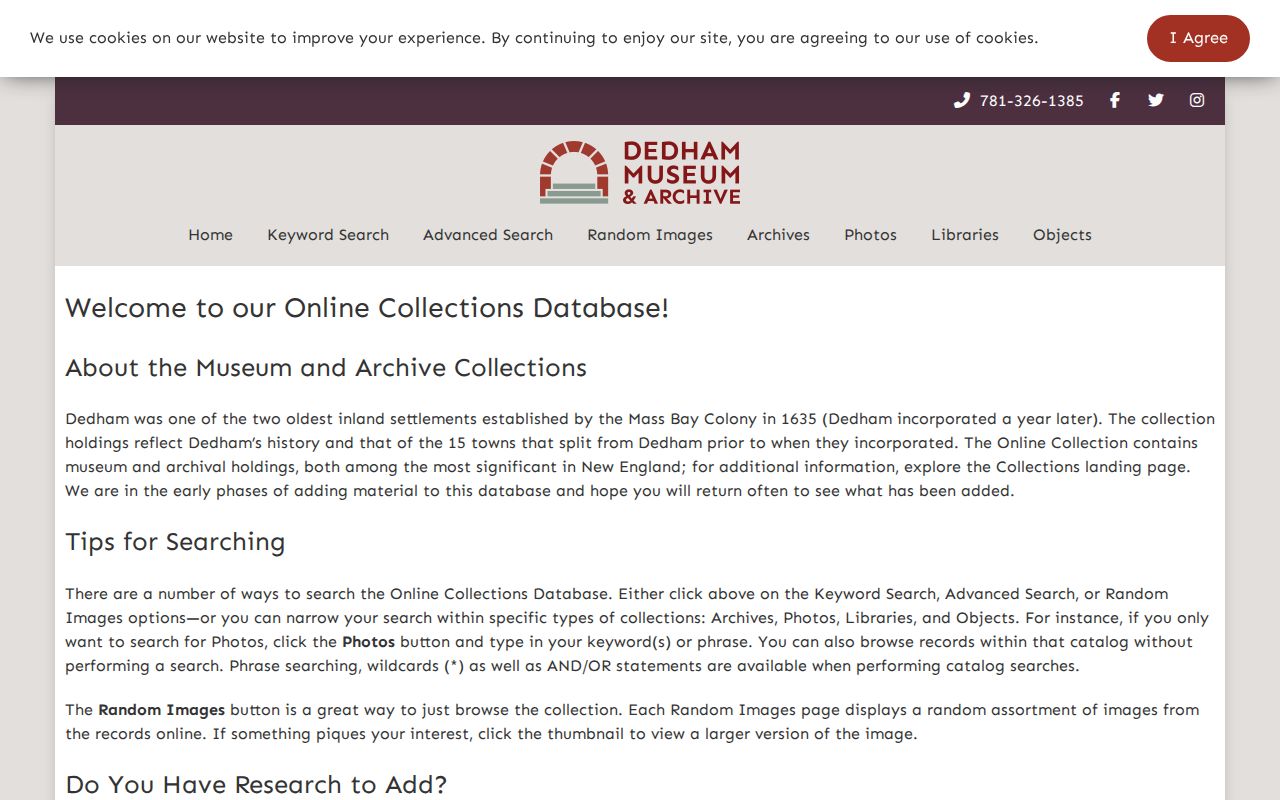
A Norfolk County catalog result can lead to a physical item rather than a downloadable scan. Keep the collection title, item reference, and access note with any directory clue, then ask the archivist about appointment, reproduction, and material that has not been digitized. The archive finding aids describe roughly 600 Dedham family collections from the seventeenth century to the present, including deeds, maps, buildings, organizations, and genealogy.
Norfolk County 1890 Directory Volume
For Norfolk County, History and Directory of Wrentham and Norfolk, Mass. for 1890 was compiled and published by A. E. Foss & Co. of Needham and printed by Brown Bros. of Boston. Its 138 pages combine a resident directory, a street directory, a business directory, town officers, schools, societies, churches, post offices, and local history. Wrentham's Street Directory begins at printed page 91 and its Resident Directory at page 103; the Norfolk resident section begins later in the volume at printed page 136.
That mix supplies a Norfolk County researcher with more than a name check. A family or address can be tested against the street section, a business listing, an institution, or a locality label within the same edition. The volume is a historical source, not a current record. Its spelling, punctuation, and locality terms should be transcribed as printed, then compared against an image because the scan's text recognition can misread surnames and abbreviations.
Source labels matter. Record whether an observation came from an original directory image, an archival catalog, a deed index, or a later supporting source.
Reading a Norfolk County Directory Entry
Norfolk County city directory entries in the 1890 volume are compact and uneven by design. They can give a name, a trade or business association, a residence marker, a street, and a locality abbreviation in one line. For example, the visible key defines h. as house, b. as boards, rd. as road, and P.O. as post office. A parenthetical mark can be a locality clue rather than part of the street address.
| Personal name | Transcribe initials and spelling exactly, then test variants in other sources. |
|---|---|
| Trade or business line | A historical disambiguator, sometimes paired with a mill, shop, or firm. |
| Residence marker | h. identifies a house in the inspected abbreviation key; it is not a title record. |
| Street and locality | Street names can omit the word “street” and may carry a printed locality code. |
| Institutional clue | Schools, churches, officers, societies, and post offices can help distinguish same-name entries. |
- Criss-cross directory
- A street-ordered section that lets an address or street name lead to historical occupants or businesses when the volume includes one.
- Householder index
- A name-ordered list centered on the household contact, which may omit boarders or other people associated with the address.
- Abbreviation key
- The printed decoding list, often near the beginning of a directory section. Preserve it before interpreting any shorthand.
No Norfolk County printed entry proves ownership. A directory can establish a dated presence or association, while a deed can establish a recorded transfer. Preserve each role as the source states it.
Norfolk County Directory Street Sections
The Wrentham section's dedicated Street Directory is the Norfolk County city directory address-to-occupant layer. It is more useful than a surname list when an old road name or a house location is already known. Later reverse or criss-cross titles may exist in local holdings, but the verified research did not establish one countywide publisher or a uniform sequence. Confirm the title, years, and whether the volume is actually street-ordered before relying on it.
Across Norfolk County, printed locality abbreviations can make a stable address look like a move. The 1890 directory uses P for Plainville, S for Sheldonville, W.W. for West Wrentham, and N.A. for North Attleboro. Historical place names can refer to a village, station, mill district, or postal route rather than a present municipal boundary. Retain the printed label and map the modern municipality as a separate field.
Tracing Norfolk County Directories
For Norfolk County family history, follow one identity across a small sequence of confirmed years rather than trying to force a continuous account from scattered editions. Pairing a directory with a federal census adds household structure, ages, birthplaces, and relationship fields to the street and trade clues in the printed volume. Publication timing, an enumerator's schedule, seasonal movement, or a boarder can explain a difference without making either source wrong.
- Start with the earliest confirmed surname and town in a directory edition, recording the title page and printed page.
- Check the next available edition for spelling changes, an initial, a street, a firm, or a locality label.
- Use the street section where available to test whether the address and nearby institutions fit the same person.
- Pair the closest federal census year with the town and household, keeping census geography separate from modern municipal names.
- Use a newspaper, cemetery file, probate record, deed, or archive collection to test a disappearance, move, or death-date lead.
A Norfolk County name that appears once is a lead, not a conclusion. Search initials, spouse or parent names, former street labels, a business affiliation, and nearby streets. The historical shelf can establish a careful timeline without turning a single directory line into a claim about title, family relationship, or present residence.
Norfolk County Directory Gaps
Norfolk County contains 28 municipalities, and Norfolk County historical sources do not always use their current boundaries or familiar postal labels. Brookline, Braintree, Milton, Quincy, and Weymouth can carry metropolitan or postal identities that obscure the county setting. The 1890 volume also preserves older terms such as Plainville, Sheldonville, West Wrentham, North Attleboro, and City Mills. A town name should be saved with the source rather than silently standardized away.
When a Norfolk County directory search fails, move sideways to the State Library genealogy route, the Massachusetts Archives item, Dedham Museum's newspapers or house-history material, a federal census, or a Registry grantor/grantee search. Dedham's High Street record corridor places the Registry and courts near the county-seat archive context, but each custodian holds a different kind of evidence. A documented gap is more useful than a guessed match.